St. Peter’s Pightle

Blyth Woods has a new project and work is well underway.

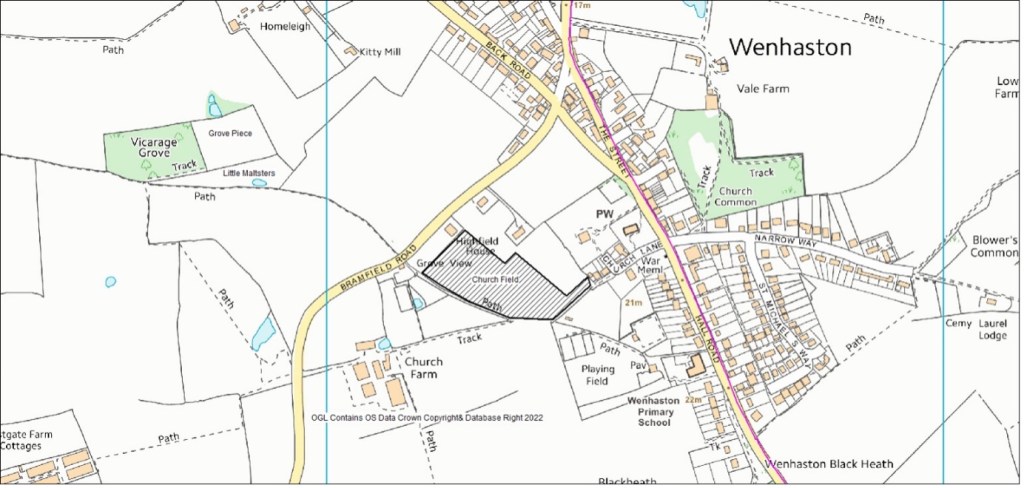
Blyth Woods is now leasing a ,1.83 ha (4.52acres) field near the church in the centre of Wenhaston. The exact location is marked on the map below where the field is referred to as Church Field. The field is owned by Wenhaston Town Estate Church Charity and a 25year lease has been arranged. We have agreed a name for the new wildlife space which is St. Peter’s Pightle.

Our aim is to improve the biodiversity of the area by establishing a rich and varied habitat for plants, invertebrates, amphibians, birds and mammals.

The 1927 OS maps list the site as allotments and the 1945 aerial photos show it in arable production with the same boundary as we are leasing.

An overgrown ditch runs along the southern boundary and soil compaction through continued farm use has resulted in issues of run off in times of heavy rain. The field slopes towards the ditch and so it is proposed to dig one or two small attenuation ponds to retain water and create a wildlife resource. Their ability to retain permanent water will be subject to soil conditions .

The hedge line that was removed in the 1960’s will be replanted along with the rest of the boundary that has no tree cover.

Site location Central grid reference TM42275 75389

Pink line denotes AONB boundary

The two sites, Grove Woods and St Peter’s Pightle, are linked by hedgerows with the only gap being the narrow Bramfield Road and therefore gives connectivity to the surrounding countryside.

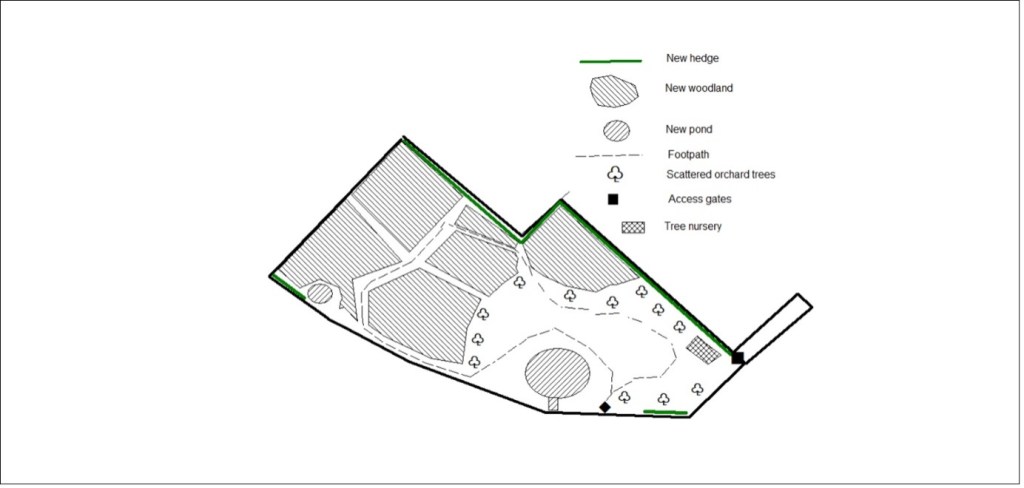
As part of the Climate Action Conference, Schools Day, we invited a group of children to suggest how we could enrich the habitat and make it an attractive place for people. They came up with some great ideas. Click here to view their plans.

We then consulted with the local community and asked for their ideas, comments and opinions on the proposed plans. Feedback was positive and encouraging.

Applications were made to bodies providing free trees such as Suffolk Tree Wardens, Woodland Trust, Conservation Volunteers, E Trees and a series of work parties were planned for planting.

Wenhaston Primary School have also applied for additional hedging for the field . The school have plans to work with a local group on geography field work in the near future.

There are several other expenses involved in the work and so applications have been made to a variety of bodies. So far we have;-

£693.55 from the Community and Conservation Fund Panel for fencing and gates.

£1800 from   local district councillor for wild flower and grass seed and fruit trees

£600 from Parish Council for a new children’s tree nursery

We are also very grateful to individuals who have made donations to Blyth Woods for the project at St Peter’s Pightle and we would like to encourage others to support the work with financial donations and by giving time to help at work parties.

Working with Wenhaston Primary School -Tree seed collection and planting

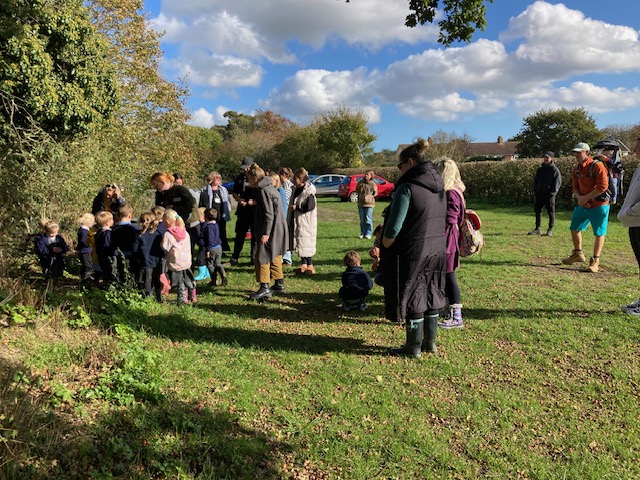
The 18th October was a busy day for Blyth Woods. Not only did we launch our new project , but in the afternoon Acorn class went hunting for acorns . The family members turned out in record numbers and showed interest in the school connection and work, as well as the new possibilities for a Blyth Woods project.

The children were very enthusiastic and the acorns were everywhere so they collected lots to plant. Before we returned to school we took the class to the new field and showed them how it looked at the very beginning of the new project. The children found eight oak seedlings in the field and talked about how they got there. They left a cane beside each one so that we can rehome the trees while the field is prepared for planting.

Back at school we tested the acorns, hazel nuts and sweet chestnuts to find out which ones were suitable for planting, a good floating and sinking activity, air in the nut is a sign of damage .

The bed in the tree nursery is now full of tree seed and we all wished the young trees ‘Good Luck’. 

We had a few minutes to spare before the children were to go into assembly and so we played the Squirrel Game. The children had to sleep like a squirrel, eat like a squirrel and talk like a squirrel ( a little bit anthropomorphic but good fun!) They then ran off and hid their acorn to (pretend) eat at another time. After a bit more talking and sleeping they all went back to find their acorn to eat. Two acorns were not found so that perhaps explains why we found oak trees growing in the middle of the field earlier in the day. 

An Inspiring Speaker at the Annual Meeting!

The Annual Meeting of the Blyth Woods group in the Village Hall on 9th May was very well attended.  

It began with a report by Alan Miller, our Chairman, on the year’s activities, from monitoring the nest boxes in Vicarage Grove, increasing the diversity in Malster’s Little Field through spreading a combination of seed, green hay and plug plants, to clearing more holly in Vicarage Grove (which has resulted in a wonderful carpet of bluebells this year), as well as managing the new trees and removing or replacing guards.  Our June Bioblitz in Grove Piece resulted in twenty-eight new species found, mainly plants and invertebrates (this year’s Bioblitz is on 13th July, when we will be looking particularly at grasses), and a fungi survey was carried out in October. Vicarage Grove is now on the Ancient Woodland Register.  

Extra fruit trees were planted and mulched in the Merton Wood Orchard. The information board in Grove Piece has been updated and two new direction signs installed. The imaginative programme with Wenhaston Primary School, educational and fun, continues successfully and is much enjoyed by the children. As well as the various community events in our Village Hall, we attended the Halesworth Climate Conference.

Finally, we hope to secure another piece of land later in the year – watch this space!

 Alan reminded everyone that at last year’s Annual Meeting we formed Wilder Wenhaston, which now involves over forty people. It is currently undertaking survey work on the river Blyth, monitoring pollution and wildlife (which turned out to be very relevant to the content of our speaker’s talk). 

Alan finished by thanking all the volunteers who have so kindly helped us during the year, before we had a break for wine, soft drinks and delicious home-made refreshments.  

After that we had an illuminating and concerning talk from Darren Tansley, the Wilder Rivers and Protected Species Manager of the Essex Wildlife Trust, on ‘Conservation at a Landscape Scale.’ He was such a passionate and articulate speaker that he held us all transfixed.

He began by asking, ‘What is a river?’

His slides showed how the natural course of a river has been forcibly altered and simplified by man over time into a straight channel for his convenience. The flooding that this causes in winter, the so-called ‘flood plain’, is the river trying to revert to its original course.

In addition, there are threats to the connectivity of a river’s habitat: human population growth and need for new housing has resulted in houses being built in the wrong place; climate change and man’s behaviour has impacted wildlife (which uses the river as an essential artery), and caused a biodiversity crisis;  and we now have sewage in our rivers for various reasons – there were, for instance, 2,000 spills of sewage into one Essex river in a year. Minute debris from car tires, etc, also goes straight into any river close to a road. Plastic pollution is building up: plastic flows all the way to estuaries and tiny particles are swallowed by fish and small mammals.  We have non-native species that should not naturally be there, such as floating pennywort, which covers the surface and blocks out vital oxygen for fish.

We are responsible for other threats to the river’s wildlife: the gates and locks that fish can’t swim past, the weirs that are impassable for fish, the removal of branches that provide shade and shelter for young fish to shoal. Flooding impacts the burrowers on the river bank, such as voles, which try to block their precious holes with earth,(much as we do with our sandbags!).

Soil and water are our most important resources. So what can we do?

We must stop taking out meanders and restore the old river channels.

We must restore the hedgerows that prevent fields flooding into each other.

We should increase the beaver population. They slow up flood water with their dams and increase biodiversity.

We should remove the barriers we’ve created and create more shade on the banks, so that fish don’t die in the heat.

Darren finished on a positive note. We are the only region in the UK with an expanding water vole population. This is because their predator, mink, has been eradicate by a programme of ‘smart’ traps.

Patricia Elliot.